
Discounts can be one of the easiest ways to encourage customers to buy from your Shopify store. But there is a problem with relying too heavily on discounts: when customers see sales and coupon codes everywhere, they can start expecting them.
Instead of buying at the regular price, they may wait for the next promotion.
Instead of asking, “Do I need this product?” they may ask, “Can I get this cheaper?”
And for Shopify merchants, constantly discounting products can gradually reduce your profit margin without necessarily creating the kind of customer loyalty you want.
So, does that mean you should stop offering discounts?
Not necessarily.
The better approach is to make your discounts more targeted, more meaningful, and more connected to customer behavior.
This is where reward coupons can become useful.
Rather than giving everyone 20% off everything, you can give a customer a coupon after they complete a specific action. They might leave a product review, make their first purchase, refer a friend, join your loyalty program, or reach a particular spending threshold.
The reward feels earned rather than automatic.
And because the coupon is connected to an action you want customers to take, you’re not simply reducing the price. You’re using a discount to support another business goal, such as generating reviews, encouraging a second purchase, increasing customer engagement, or building long-term loyalty.
In this guide, we’ll explain how to use reward coupons in Shopify, why they can be more sustainable than storewide discounts, which customer actions you can reward, and how to create a reward strategy that encourages sales without training customers to wait for your next sale.
Table of Contents
Why Reward Coupons Can Be Better Than Storewide Discounts
A storewide discount is easy to understand. Everyone gets the same offer. That simplicity can be useful for major campaigns, seasonal events, product launches, or clearance sales. But it isn’t always the best strategy for everyday marketing.
Imagine that you sell skincare products and offer 15% off your entire store every weekend. At first, customers may feel excited about the promotion.
After a few weeks, however, some shoppers may simply wait for the next weekend. The discount has become part of your normal pricing expectation. Reward coupons create a different relationship.
Instead of telling every visitor, “Everything is cheaper today,” you’re saying, “Here’s something valuable you can earn by doing something that helps you and the store.”
This creates a give-and-get relationship. The customer receives a benefit, while your business takes an action with potential long-term value.
For example: Customer leaves a review → Store gains social proof → Customer receives a coupon → Customer returns to shop again
This doesn’t mean reward coupons will always outperform broad discounts. The result depends on your products, margins, customer base, offer, and implementation. But they give Shopify merchants another way to use discounts without making a permanent storewide price reduction the center of their marketing strategy.
How to Use Reward Coupons to Boost Sales without Discounting Everything
Use this table as the map for the sections below. Each row is one reward type, the action it asks for, and the rule that keeps it from turning into a storewide coupon.
| Reward | Customer Action | Typical Offer | Rule that protects margin |
| Review reward | Leaves a product review, photo, or video | Small code after the review is in | Send it after they have used the product, not at checkout |
| Next-purchase coupon | Completes an order | Code for the following order | One use, tied to that customer, not a public sitewide code |
| Minimum-spend reward | Adds more to the cart | $10 off orders of $60 or more | Set a threshold above your average order so the discount is earned |
| Loyal or returning customer | Comes back, or has already bought | Private code for known buyers | Reward one behavior, not email opens plus follows plus signups |
| Limited-time coupon | Acts during a launch, season, or reactivation | Code with a real start and end date | Use a deadline only when the campaign actually ends |
| Specific reward message | Reads why they got the code | “Thanks for your review. $10 off your next order over $60.” | Name the action, the amount, the minimum, and what it applies to |
Pick one row as the main campaign. Add a second only after the first has a clear rule for who gets the code, what it applies to, and when it stops.
1. Reward Customers for Leaving Product Reviews
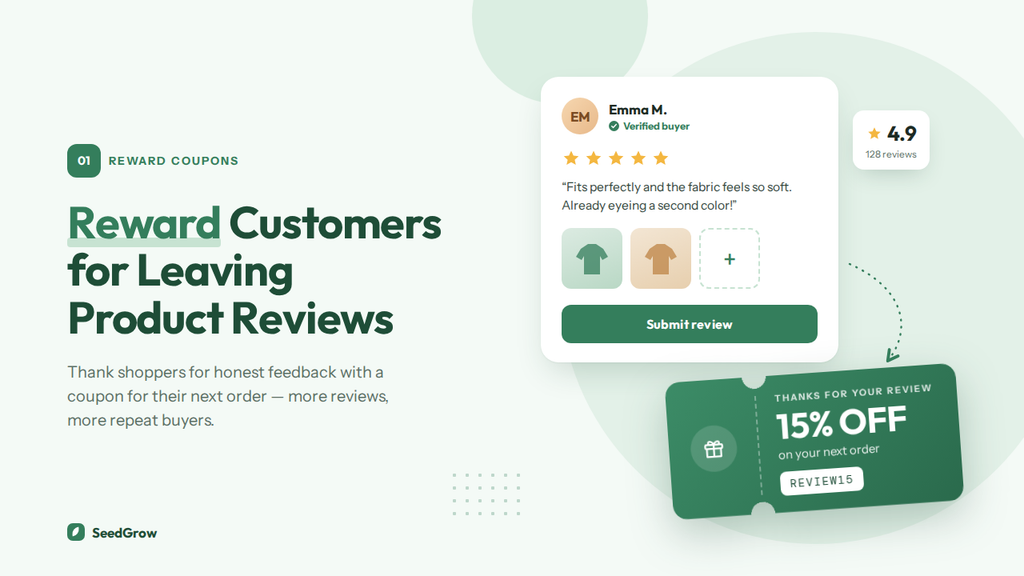
One of the most practical ways to use reward coupons is to connect them with customer reviews.
Reviews are valuable because they help future shoppers evaluate products before purchasing. A product page with customer experiences, ratings, photos, and videos can answer questions that your product description alone cannot.
But getting customers to leave reviews isn’t always easy. A customer may be perfectly happy with their purchase and still forget to leave feedback. This is where a reward can provide an additional reason to take action.
2. Give Customers a Coupon for Their Next Purchase
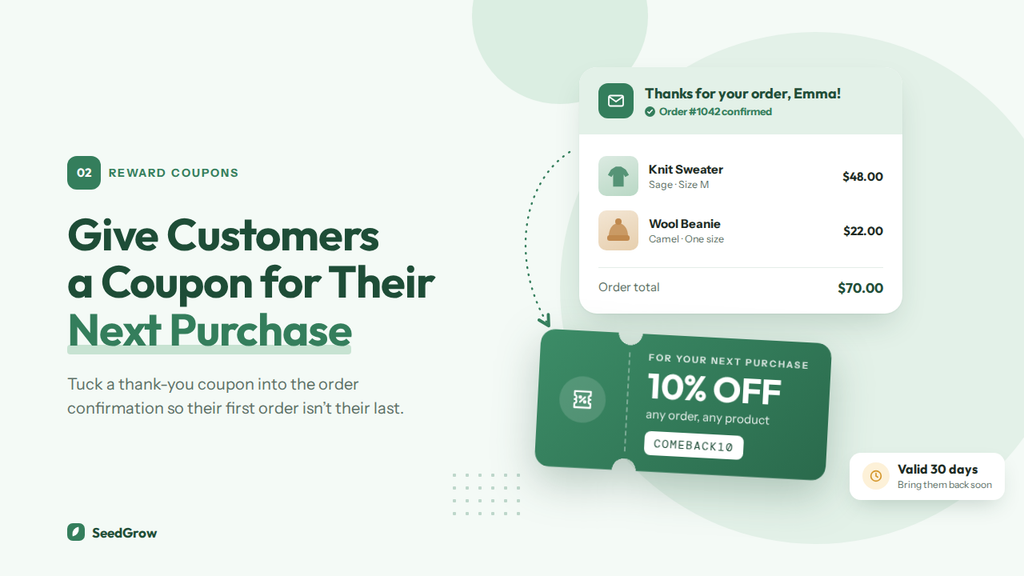
Another effective approach is to use reward coupons specifically to encourage repeat purchases.
Getting someone to place their first order is only one part of ecommerce growth. If that customer never comes back, you have to continuously spend time and money acquiring new shoppers.
A reward coupon can give an existing customer a reason to return.
You could send the reward immediately after purchase, or after a specific action such as leaving a review.
However, don’t make the coupon so generous that it encourages customers to buy only when a discount is available.
A fixed amount or modest percentage can often be enough to create a reason to return.
Shopify allows discount codes to have active periods and usage restrictions, so merchants can control when a discount is available and how frequently it can be used.
The exact expiration period should depend on your normal repurchase cycle. A store selling consumable products may use a shorter window because customers naturally need to reorder sooner, while a store selling furniture or high-ticket products may need a much longer period.
3. Use Minimum-Spend Rewards to Increase Order Value
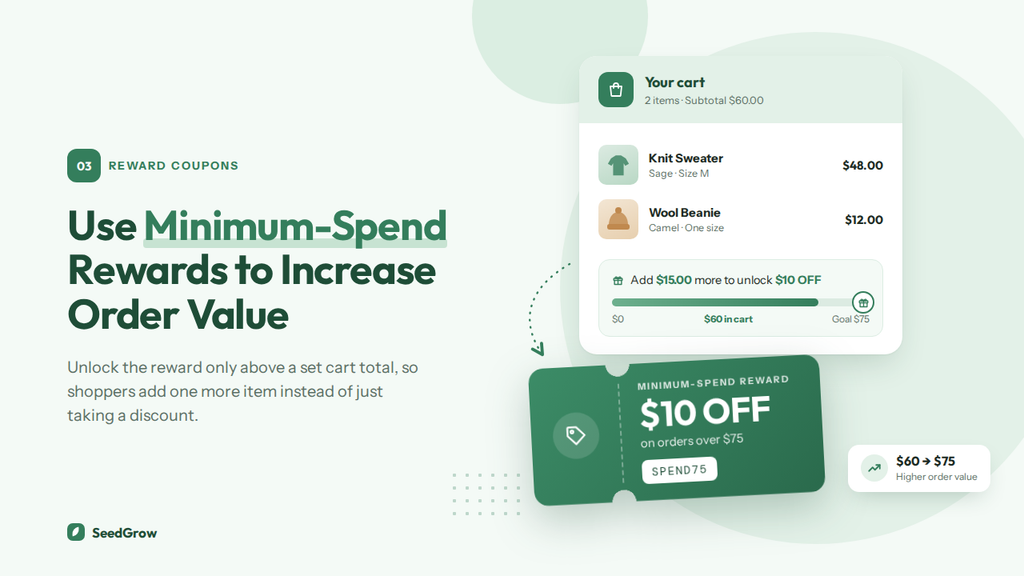
Reward coupons don’t have to be designed only for repeat purchases. They can also encourage customers to spend more per order. This is where minimum-spend rewards become useful.
Reward coupons don’t have to be designed only for repeat purchases. They can also encourage customers to spend more per order. This is where minimum-spend rewards become useful.
The most important part is choosing a realistic threshold. If your average order value is $40, offering a $200 reward may feel completely out of reach. On the other hand, setting the threshold at $42 may not create enough incremental spending to justify the reward.
Shopify supports minimum purchase requirements for discount codes and automatic discounts, giving merchants a native way to set conditions based on spending thresholds.
4. Create Rewards for Loyal or Returning Customers
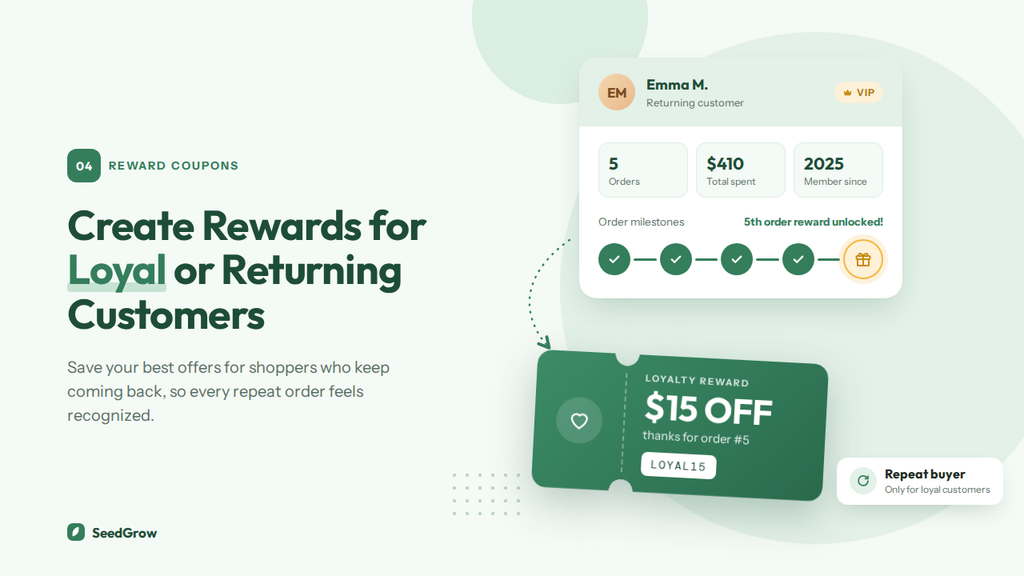
Not every reward needs to be connected to a review.
You can also use coupons to recognize customers who have already shown interest in your brand.
If customers receive a coupon for opening an email, visiting a product page, following your social account, leaving a review, making a purchase, and signing up for your newsletter, your reward system can quickly become complicated.
Choose the behaviors that have the strongest connection to your business goals.
If reviews are your biggest priority, reward reviews.
If repeat purchases are the priority, focus on next-order rewards.
If increasing AOV is the goal, consider minimum-spend rewards.
The best reward strategy is usually the one that is simple enough for customers to understand and valuable enough for them to care about.
5. Use Limited-Time Reward Coupons
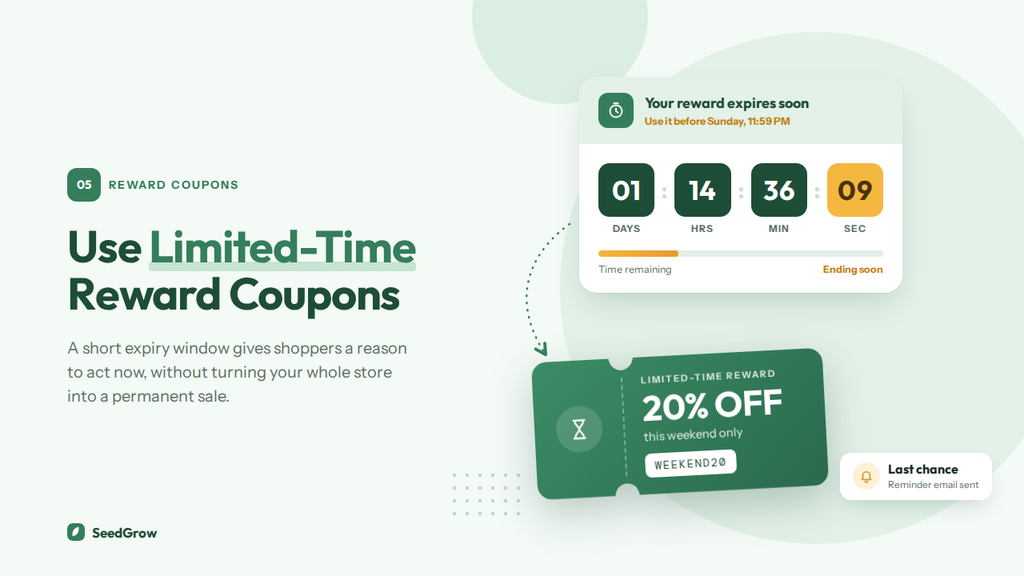
Urgency can make a reward more actionable. Limited-time reward coupons can be especially useful around seasonal campaigns, product launches, customer reactivation campaigns, and other specific marketing events.
Shopify supports start and end dates for discount codes, so merchants can schedule when their promotional codes are active.
However, don’t make every reward extremely urgent.
If customers constantly receive “expires tonight” messages, the urgency can start feeling artificial.
Use deadlines when there is a genuine reason for them.
6. Make Your Reward Coupons Specific
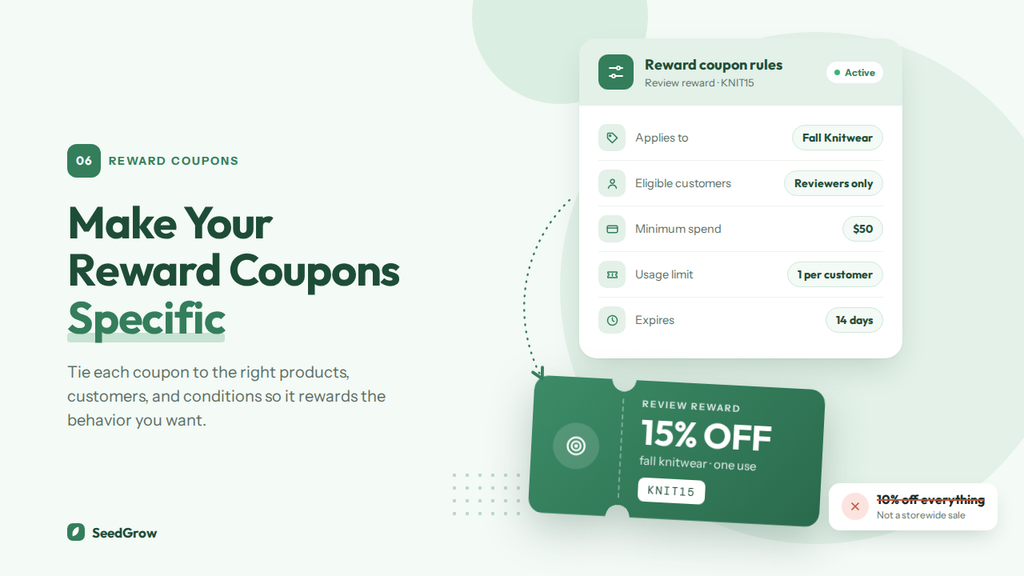
One of the easiest ways to make reward coupons less effective is to make them too vague.
For example: Here’s a discount for you! The customer may not understand why they received it, what it applies to, or why they should use it now.
Instead, explain the relationship between the customer’s action and the reward.
For example: Thanks for sharing your review! Enjoy $10 off your next order over $60.
Shopify discount codes can be configured with minimum order amounts, specific products or collections, customer eligibility, usage limits, active dates, and combination rules.
These controls are important because a reward coupon should support your strategy, not accidentally create a larger discount than you intended.
Common Mistakes You Need to Avoid While Dealing with Shopify Reward Coupons
Reward coupons only help if they stay tied to one action and one clear rule. The usual failure is treating them like a second storewide sale: same code for everyone, no minimum, no end date, and no note about what the customer did to earn it. Fix these before you publish the next campaign.
- Discounting the entire catalog instead of rewarding a single action: A blanket 20% off trains shoppers to wait for the next code. Tie the coupon to a review, a first order, a referral, or a return visit, and say that in the message.
- Stacking too many reward triggers: A code for opening an email, following a social account, leaving a review, and signing up for the newsletter makes the offer hard to explain. Pick the behavior that matches the goal. Reviews if you need social proof. Next-order codes if you need repeat sales. Minimum-spend codes if you need a higher cart.
- Skipping a minimum order amount: A flat discount on a small order can wipe the margin on the item you just sold. Shopify discount codes support a minimum purchase. A $10 reward on orders of $60 or more is easier to defend than $10 off anything.
- Letting codes stack with every other promotion: Combination rules matter. A reward on top of an automatic sale, a free-shipping code, and a collection discount can cut deeper than you planned. Limit what the reward can combine with, and restrict it to the products or collections you want to move.
- Using fake urgency on every coupon: Start and end dates are useful for launches, seasonal pushes, and reactivation. “Expires tonight” on every email stops working. Use a deadline when there is a real reason, and leave everyday rewards with a normal window.
- Sending a vague code with no reason attached: “Here’s a discount for you” does not tell the shopper what it applies to or why they got it. Write the link between the action and the reward: thanks for the review, $10 off the next order over $60. For review rewards, an app such as SeedGrow Product Reviews & Rewards can send the request and attach the coupon so the code is not a manual afterthought.
Frequently Asked Questions About Reward Coupons on Shopify
Here are some frequently asked questions and answers regarding reward coupons on Shopify.
- What are reward coupons?
Reward coupons are discount codes given to customers after they complete a specific action or meet a condition. Examples include leaving a product review, making a purchase, reaching a spending threshold, or participating in a loyalty program.
- Are reward coupons better than storewide discounts?
They serve different purposes. Storewide discounts can be useful for major promotions, while reward coupons connect the discount to a specific customer action. This can make the discount more targeted and help merchants achieve an additional business goal.
- How can I use coupons to get more product reviews?
You can offer customers a discount code after they submit a review. For example, you might offer 10% off their next purchase after they leave a review. A Shopify app such as SeedGrow Product Reviews & Rewards can automate review requests and provide discount rewards for reviews.
- Can I reward customers for photo and video reviews?
Yes. You can structure a reward campaign around customer-generated content, such as photos and videos, if your review solution supports those formats. SeedGrow Product Reviews & Rewards supports photo and video reviews and built-in discount rewards.
- Can I limit a Shopify reward coupon to one use?
Yes. Shopify allows merchants to configure discount usage limits, including limiting a discount code to one use per customer.
- Can I add an expiration date to a reward coupon?
Yes. Shopify discount codes can be configured with active dates, allowing you to create rewards that expire after a defined period.
- Can I require customers to spend a certain amount before using a reward?
Yes. Shopify supports minimum purchase requirements for discount codes. For example, you could create a reward that gives $10 off orders of $60 or more.
- How much should I discount with a reward coupon?
There is no universal percentage that works for every Shopify store. Consider your margins, average order value, customer lifetime value, and the value of the action you’re rewarding. Start with a sustainable offer and test the results rather than assuming that a larger discount will automatically create more profitable sales.
- Can reward coupons increase repeat purchases?
They can provide an additional reason for customers to return, particularly when the reward is designed specifically for a future purchase. However, measure repeat purchase behavior and revenue rather than assuming that every redeemed coupon represents incremental sales.
Final Thoughts
The goal of a discount shouldn’t always be to make your products cheaper.
A better question is: What do I want the customer to do, and can a reward give them a reason to do it?
If you want more product reviews, reward reviews.
If you want more customer-generated content, reward photo or video reviews.
If you want higher order values, use minimum-spend rewards.
If you want more repeat purchases, provide a coupon for the next order.
If you want to reconnect with inactive customers, create a targeted reactivation offer.
This approach allows you to use discounts without turning your Shopify store into a permanent sale.
There are many ways to implement reward campaigns. Shopify’s native discount tools can handle straightforward coupon rules, while dedicated apps can help automate more specialized customer journeys.
For merchants seeking to integrate product reviews and customer rewards, SeedGrow Product Reviews & Rewards is a viable option. By combining review requests, customer-generated content, and reward coupons, this approach can turn the simple act of asking for feedback into a broader customer-engagement workflow.
Ultimately, the most sustainable discount strategy isn’t necessarily the one that gives customers the biggest discount.
It’s the one where the customer gets something valuable, and your store gets something valuable in return.
Do you know any other way to use reward coupons to boost sales without discounting everything?
Let us know in the comments.
